
Overview - Surah 22: al-Hajj (The Pilgrimage )
The Surah reminds about the approaching end of the world, need for the firmness of faith to support the truth and to eradicate the evil. It talks about prayers, humbleness and sacrifice, respect of the Ka'bah, the House of Allah, and striving to defend the truth.
Sections:
- The Shaking of the Last Hour. Arguments for the Resurrection from the stages of human creation and from the rain that produces vegetation.
- The marginal Muslims and their end.
- The true believers shall be rewarded.
- Pilgrimage to the House of Allah.
- Respect of the Symbols of Allah.
- The permission of fighting back is granted to those to whom wrong is done.
- Satan's enticements and Allah's especial protection of His words.
- The reward of those who migrate in the cause of Allah.
- Allah's order prevails in the heaven and earth.
- The Muslim community is chosen by Allah for a special purpose.
Named after the obligation of the pilgrimage to Makkah - The Hajj. The word 'Hajj' is only mentioned once in this Surah, وَأَذِّن فِي النَّاسِ بِالْحَجِّ يَأْتُوكَ رِجَالًا وَعَلَىٰ كُلِّ ضَامِرٍ يَأْتِينَ مِن كُلِّ فَجٍّ عَمِيقٍ "And proclaim to the people the Hajj [pilgrimage]; they will come to you on foot and on every lean camel; they will come from every distant pass -" [22:27]
There are 78 Ayat in this Surah.
Overview
| Total Ayat | 78 |
| Total Words * | 1274 |
| Root Words * | 335 |
| Unique Root Words * | 16 |
| Makki / Madani | Madani |
| Chronological Order* | 103rd (according to Ibn Abbas) |
| Year of Revelation* | 12th year of Prophethood |
| Events during/before this Surah*
2nd Pledge of Aqabah, 1st Pledge of Aqabah, Death of Abu Talib - Death of Khadijah - Stoning at Ta'if - al-Isra wal Mi'raj - Night Journey, Boycott of Banu Hashim Yr 3, Boycott of Banu Hashim Yr 2, Boycott of Banu Hashim Yr 1, 2nd Migration to Abyssinia, Physical beating and torture of some Muslims - 1st Migration of Muslims to Abyssinia, Public Invitation to Islam - Persecution of Muslims; antagonism - ridicule - derision - accusation - abuse and false propaganda., Revelation begins - Private Invitation to Islam , Revelation begins - Private Invitation to Islam , Revelation begins - Private Invitation to Islam
| |
| Events during/after still to occur*
,Migration from Makkah to Madinah - Building of Masjid Nabi in Madinah - Treaty with Jews of Madinah - Marriage of Prophet to Aishah,Change of Qiblah from Jerusalem to Makkah - Battle of Badr,Battle of Uhud,,Battle of Ahzab - Expedition of Banu Quraydhah,Treaty of Hudaiybiyah - Letters to Kings and Rulers,,Conquest of Makkah - Battle of Hunain,Hajj led by Abu Bakr - Expedition of Tabuk,Farewell Hajj by Prophet - Death of Prophet - End of Divine Revelation
| |
| Names of Prophets Mentioned
Nuh, Lut, Ibrahim, Musa
| |
| Surah Index
‘Aad, Abraham, Adversity (patience during) , Ageing, God (a day for Him is ) (a thousand human years), God (wills no wrong to His creation) , Angels, Astronomy (celestial mechanics) , Astronomy (celestial mechanics) (moon), Astronomy (celestial mechanics) (sun), Astronomy (stars) , Beasts, Behaviour (each group given a law and way of life) (and a way of worship), Cattle, Charity, Charity (during the Hajj) , Christians, Churches, Clothing (of fire) , Commandments (general religious) , Death, Death (in God’s cause) , Disbelievers, Disbelievers (God’s promise to) , Earth, Earth (condition of at the time of resurrection) , Earth (inclination of rotational axis to orbital plane) , Embryology, Fighting, Fighting (when ordained) , Food, Grave, Hajj, Hell, Humankind (creation of) (from a drop of sperm), Humankind (creation of) (from dust), Iblis, Jews, Jihad, Jihad (striving hard in God’s cause) , Judgement (Day) , Ka’bah, Life (extra-terrestrial) , Lot, Madyan, Magians, Moses, Noah, Prayer (prostration) , Religion, Religion (no hardship in) , Resurrection, Resurrection (Day) , Resurrection (of humans) , Revelation, Sabians, Sea, Ships, Silk, Synagogues, Thamud, Trees, Weather (rain)
| |
This Surah is addressed to:
- The polytheists of Makkah,
- The wavering Muslims and
- The True Believers.
The polytheists have been warned in a forceful manner to this effect: “You have obdurately and impudently persisted in your ideas of ignorance and trusted in your deities instead of God though they possess no power at all and you have repudiated the Divine Messenger. Now you will meet the same end as has been the doom of those like you before. You have only harmed yourselves by rejecting Our Prophet and by persecuting the best element of your own community; now your false deities shall not be able to save you from the wrath of God.” At the same time they have been admonished time and again for their creed of polytheism (Shirk) and sound arguments have been given in favour of Monotheism (Tawhid) and the Hereafter. The wavering Muslims who had embraced Islam but were not prepared to endure any hardship in its way have been admonished to this effect: “What is this faith of yours? On the one hand you are ready to believe in God and become His servants provided you are given peace and prosperity but on the other if you meet with afflictions and hardships in His Way you discard your God and cease to remain His servant. You should bear in mind that this wavering attitude of yours cannot avert those misfortunes and losses which God has ordained for you.”
As regards the true Believers they have been addressed in two ways:
- In a general way so as to include the common people of Arabia also and
- In an exclusive way.
The Believers have been told that the polytheists of Makkah had no right to debar them from visiting the Holy Mosque. They had no right to prevent anyone from performing Hajj because the Holy Mosque was not their private property. This objection was not only justified but it also acted as an effective political weapon against the Quraysh. For it posed this question to the other clans of Arabia: Were the Quraysh mere attendants of the Holy Mosque or its owners? It implied that if they succeeded in debarring the Muslims from Hajj without any protest from others, they would feel encouraged in future to debar from Hajj and Umrah the people of any other clan, who happened to have strained relations with the Quraysh. In order to emphasize this point, the history of the construction of the Holy Mosque has been cited to show that it was built by Prophet Abraham by the Command of God and he had invited all the peoples to perform Hajj there. That is why those coming from outside had enjoyed equal rights by the local people from the very beginning. It has also been made clear that that House had not been built for the rituals of polytheism (shirk) but for the worship of One God. Thus it was sheer tyranny that the worship of God was being forbidden there while the worship of idols enjoyed full licence
In order to counteract the tyranny of the Quraysh, the Muslims were allowed to fight with them. They were also given instructions to adopt the right and just attitude as and when they acquired power to rule in the land. Moreover, the Believers have been officially given the name of “Muslims” saying, “You are the real heirs to Abraham and you have been chosen to become witnesses of the Truth before mankind. Therefore you should establish prayer (salat) and pay the financial obligation (zakah) in order to become the best models of righteous life and perform Jihad for propagating the Word of God (v. 41,77, 78.) It will be worthwhile to keep in view the introductions to Surah 2: al-Baqarah (The Cow) and Surah 8: al-Anfal (The Spoils of War).
Manuscripts / Inscriptions

18th Century
18th Century
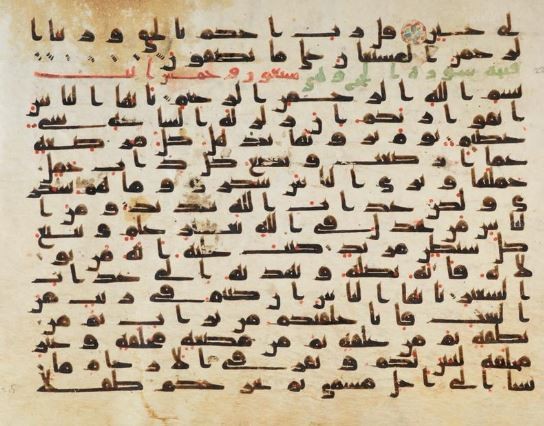
3rd /4th Century Hijrah
3rd /4th Century Hijrah
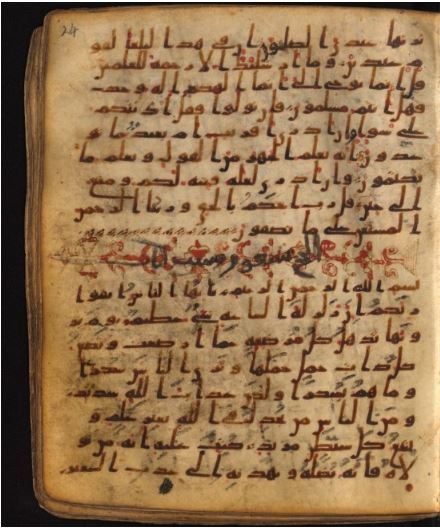
1st Century Hijrah
1st Century Hijrah
-
Uqbah bin Amir narrated: "I said: 'O Messenger of Allah! Surah Al-Hajj has been esteemed by two prostrations?' He said: 'Yes, and whoever does not prostrate for them, he should not recite them.' [Jami` at-Tirmidhi 578]
- This is the first Surah in which the Muslims have been allowed to fight
- Some Ayat were revealed in Makkah and some in Madinah.
- Some Ayat were revealed during travel and some whilst the Prophet was settled.
- There are two Ayat of prostration in this Surah.
Surah al-Hajj has 14 unique words used only once in the whole of the Qur'an [only exception is the last word 'fly' which was used twice - but in the same Ayat]
- (22:2) تَذْهَلُ Tadhahulu [will forget]
- (22:9) عِطْفِهِ Itfihi [his neck]
- (22:17) وَالْمَجُوسَ al-Majoos [the Magians]
- (22:21) مَقَامِعُ Maqami [hooked rods]
- (22:27) ضَامِر Dhamir [lean camel]
- (22:27) عَمِيقٍ Ameeq [distant]
- (22:29) تَفَثَهُمْ Tafahum [their prescribed duties]
- (22:36) وَجَبَتْ Wajabat [are down]
- (22:40) لَهُدِّمَتْ Hudimat [demolished]
- (22:40) صَوَامِعُ Sawame [monasteries]
- (22:45) وَبِئْرٍ Bi'r [a well]
- (22:72) يَسْطُونَ Yastuna [attack]
- (22:73) يَسْلُبْهُمُ Yaslubuhum [snatched away from them]
- (22:73) الذُّبَابُ Dhubab [fly]
- (22:5) is the longest Ayat of this Surah with 69 words,
يَا أَيُّهَا النَّاسُ إِن كُنتُمْ فِي رَيْبٍ مِّنَ الْبَعْثِ فَإِنَّا خَلَقْنَاكُم مِّن تُرَابٍ ثُمَّ مِن نُّطْفَةٍ ثُمَّ مِنْ عَلَقَةٍ ثُمَّ مِن مُّضْغَةٍ مُّخَلَّقَةٍ وَغَيْرِ مُخَلَّقَةٍ لِّنُبَيِّنَ لَكُمْ ۚ وَنُقِرُّ فِي الْأَرْحَامِ مَا نَشَاءُ إِلَىٰ أَجَلٍ مُّسَمًّى ثُمَّ نُخْرِجُكُمْ طِفْلًا ثُمَّ لِتَبْلُغُوا أَشُدَّكُمْ ۖ وَمِنكُم مَّن يُتَوَفَّىٰ وَمِنكُم مَّن يُرَدُّ إِلَىٰ أَرْذَلِ الْعُمُرِ لِكَيْلَا يَعْلَمَ مِن بَعْدِ عِلْمٍ شَيْئًا ۚ وَتَرَى الْأَرْضَ هَامِدَةً فَإِذَا أَنزَلْنَا عَلَيْهَا الْمَاءَ اهْتَزَّتْ وَرَبَتْ وَأَنبَتَتْ مِن كُلِّ زَوْجٍ بَهِيجٍ "O People, if you should be in doubt about the Resurrection, then [consider that] indeed, We created you from dust, then from a sperm-drop, then from a clinging clot, and then from a lump of flesh, formed and unformed - that We may show you. And We settle in the wombs whom We will for a specified term, then We bring you out as a child, and then [We develop you] that you may reach your [time of] maturity. And among you is he who is taken in [early] death, and among you is he who is returned to the most decrepit [old] age so that he knows, after [once having] knowledge, nothing. And you see the earth barren, but when We send down upon it rain, it quivers and swells and grows [something] of every beautiful kind." (22:5)
Total Word Count per Ayat (shows how many words per Ayat) = 16* | ||
| # | Root Word | Frequency in Surah | Frequency in Qur'an |
|---|---|---|---|
| 1. | أ ل ه | 77 | 2851 |
| 2. | ٱلَّذِى | 29 | 1464 |
| 3. | ن و س | 15 | 241 |
| 4. | ع ل م | 14 | 854 |
| 5. | س م و | 14 | 381 |
| 6. | ك ل ل | 12 | 377 |
| 7. | إِلَىٰ | 12 | 742 |
| 8. | ق و م | 12 | 660 |
| 9. | ع ذ ب | 9 | 373 |
| 10. | ك و ن | 9 | 1390 |
| Root Word | Frequency in Surah |
Frequency in Qur'an |
|---|---|---|
| أ ل ه | 77 | 2851 |
| ٱلَّذِى | 29 | 1464 |
| ن و س | 15 | 241 |
| ع ل م | 14 | 854 |
| س م و | 14 | 381 |
| ك ل ل | 12 | 377 |
| إِلَىٰ | 12 | 742 |
| ق و م | 12 | 660 |
| ع ذ ب | 9 | 373 |
| ك و ن | 9 | 1390 |
As this Surah contains the characteristics of both the Makkan and the Madīnan Surahs the commentators have differed as to its period of revelation but in the light of its style and themes we are of the opinion that a part of it (v. 1-24) was sent down in the last stage of the Makkan life of the Prophet a little before migration and the rest (v. 25-78) during the first stage of his Madinah life. That is why this Surah combines the characteristics of both the Makkan and the Madinah Surahs.
According to Ibn Abbas, Mujahid, Qatadah and other great commentators, v. 39 is the first verse that grants the Muslims permission to wage war. Collections of hadith and books on the life of the Prophet confirm that after this permission actual preparations for war were started and the first expedition was sent to the coast of the Red Sea in Safar 2 A.H. which is known as the Expedition of Waddan or Al-Abwa.
- Uqbah bin Amir narrated: "I said: 'O Messenger of Allah! Surah Al-Hajj has been esteemed by two prostrations?' He said: 'Yes, and whoever does not prostrate for them, he should not recite them.'" [Jami` at-Tirmidhi 578]
- A scene from the Hour of Doom.
- Human life cycle: life in this world and life in the Hereafter.
- Behavior of those individuals who were standing at the verge of faith is identified.
- The fact that Allah always helps His Rasools.
- Divine law granting equal rights to all believers in Masjid-al-Haram, whether they are natives or foreigners.
- The fact that Allah Himself identified the site and asked Prophet Ibrahim (pbuh) to build the Ka'bah and call mankind to come for Hajj (Pilgrimage).
- Someone who commits Shirk is like someone who falls from the sky and his body is snatched away by birds.
- The fact that it is not the blood or the flesh of a sacrificed animal which reaches Allah but the piety of the individual who is offering the sacrifice.
- The first Commandment of Allah granting permission to the believers to defend themselves and fight against the unbelievers and mushrikin.
- On the Day of Judgement, Allah Himself will be the Judge for all.
- Allah's promise to those who migrate for His sake that He will reward them generously.
- The fact that Allah called the Believers Muslims in the prior scriptures and also in the Qur'an
Tafsir Zone
|
Sayyid Qutb Overview (Verses 32 - 37) A Sacrifice of Distinction Having mentioned those who honour God’s sanctities and the need to preserve and protect such sanctities, the sūrah now speaks of honouring the symbols set up by God, which, in this instance, refers to the animals sacrificed as part of the pilgrimage rituals. This honour is manifested by choosing the best and most valuable animals for sacrifice: This is [to be borne in mind]. Anyone who honours the symbols set up by God [shows evidence of] God-consciousness in people’s hearts. You have benefit in them for a term appointed; and in the end their place of sacrifice is near the Ancient House. (Verses 32-33) A link is established here between the sacrifice offered by pilgrims and the way hearts are made conscious of God. The whole purpose of all pilgrimage rituals is to enhance believers’ God-fearing sense. All these rituals are symbols confirming submission to God, the Lord of the Ka`bah, the Sacred House, as also obeying Him in all situations. They may also involve reminders of old events, from the time of Abraham and later generations, but these are reminders of complete submission to God, obeying His rules and looking up to Him for guidance. Such is the mark of the Muslim community ever since its earliest days. Hence, these symbols are to be treated on an equal footing with prayer. Animals marked for sacrifice on the day when pilgrims are due to release themselves from consecration may be used by their owners. The owner may ride such animals, if they are suitable for such purpose, or he may use their milk, until they reach the place of sacrifice, which is in the vicinity of the Ancient House. They are then sacrificed there, when the owners may partake of their meat, but they must give much of it to the poor. At the Prophet’s time, Muslims used to choose the best animals for sacrifice, paying the best prices for them, as a gesture of honouring the symbols set up by God. Their only motive was their God-fearing sense. `Abdullāh ibn `Umar reports that his father received a superb she-camel as a gift. He was offered 300 dinars for it, (which was a very high price). He reported this to the Prophet and asked whether he should sell it to buy instead several camels for sacrifice. The Prophet said: “No. Make this one your sacrifice.” We note here that `Umar did not wish to sell the camel in order to save part of its price. He simply wanted to buy instead several camels or cows and sacrifice them all, although he was aware that one camel or cow was sufficient to fulfil the sacrificial duty of seven pilgrims. The Prophet, however, advised him to sacrifice the precious animal itself, for the very reason that it was so precious. While the alternative suggested by `Umar could have provided much more meat to go round, the moral aspect was intended here, because it is a demonstration of honouring the symbols set up by God. This is what the Prophet wished to highlight as he ordered `Umar to sacrifice that particular she-camel. The Qur’ān mentions that such a sacrifice ritual was known in many communities. It was left to Islam, however, to put it on its right course, offered for God alone: For every community We have appointed [sacrifice as] an act of worship, so that they might extol the name of God over whatever heads of cattle He may have provided for them. Your God is the One and Only God. Hence, surrender yourselves to Him. Give good news to those who are humble, whose hearts tremble with awe whenever God is mentioned, and who patiently bear whatever befalls them, attend regularly to their prayer and spend in charity out of what We provide for them. (Verses 34-35) Islam purifies feelings and intentions, setting them all for one goal. Thus, intentions, actions, worship and customs all serve a common purpose, setting life on the sound basis of pure faith. This is the underlying reason for prohibiting eating any meat at the slaughter of which any name other than God’s is invoked. Indeed it is essential to invoke God’s name at the sacrifice, giving prominence to such invocation, as if the sacrifice is done merely to invoke His name: “For every community We have appointed [sacrifice as] an act of worship, so that they might extol the name of God over whatever heads of cattle He may have provided for them.” (Verse 34) This is followed by a clear statement of God’s oneness: “Your God is the One and Only God.” (Verse 34) An order of submission to Him is the logical conclusion: “Hence, surrender yourselves to Him.” (Verse 34) Such surrender should be an act of choice, done with complete reassurance and without any compulsion: “Give good news to those who are humble, whose hearts tremble with awe whenever God is mentioned.” (Verses 34-35) The mere mention of God’s name stirs in them a feeling of awe that manifests itself in their actions. “Who patiently bear whatever befalls them.” (Verse 35) They do not object to whatever happens to them by God’s will. They also “attend regularly to their prayer,” showing thus that they worship God as He wishes to be worshipped. Moreover, they do not grudgingly hold on to what they have. Rather, they “spend in charity out of what We provide for them.” (Verse 35) Thus a close link is established between faith and worship rituals. The latter derive from faith and are manifestations of it. Hence, they are described as symbols set up by God. What is important in all this is that life itself derives its colour from faith, ensuring unity between beliefs and actions. The sūrah continues to emphasize the link between faith and worship rituals as it outlines some pilgrimage duties, speaking here of the sacrifice of cows and camels: “The sacrifice of camels We have ordained for you as one of the symbols set up by God, in which there is much good for you.” (Verse 36) Camels are mentioned here in particular because they are the largest and most valuable of sacrificial animals. The sūrah states that there is much good for mankind in camels: they serve as good mounts and provide plenty of milk. When they are sacrificed, they provide much meat to eat and give for charity. In return for all these benefits, people should invoke God’s name, making their purpose clear and their sacrifice purely for God’s sake. This should be clear in their minds as they bring the camels forward for sacrifice: “Hence, extol the name of God over them when they are lined up.” (Verse 36) Camels are slaughtered standing on three legs, while the fourth is tied. “After they have fallen lifeless to the ground, eat of their meat, and feed the poor who is contented with his lot, as well as the one who is forced to beg.” (Verse 36) The owners of the slaughtered sacrifice are recommended to partake of its meat, but they are required to give gifts to the poor who are contented and do not ask for charity, as well as those whose poverty makes them beg. It is because all these benefits are provided that people should give thanks to God: “It is to this end that We have made them subservient to your needs, so that you might have cause to be grateful.” (Verse 36) As people are commanded to slaughter their sacrifice invoking God’s name, it is made clear to them that “never does their meat or their blood reach God.” (Verse 37) He has no need of them. What reaches Him, however, is people’s piety and consciousness of Him. It is the intention behind any action that gives it its worth. Compare this with the practice of the Quraysh idolaters who used to splatter the blood of their sacrifices over their idols. How crude and ugly! It is to this end that He has made them subservient to your needs, so that you might glorify God for all the guidance with which He has graced you. (Verse 37) It is He who has guided you to the proper and true faith of submission to Him alone. Thus, you have become aware of the proper relation between man and God and the true meaning of action undertaken purely for God’s sake. “Give good news to those who do good,” putting their beliefs, worship and life activities on a proper footing. Thus Muslims turn to God with every move they make, at any time of the day or night, conscious of His majesty, seeking His pleasure. With this attitude, life becomes a series of acts of worship, fulfilling God’s purpose of creation. Life on earth is set on its proper basis, with a solid link between this world and the next. |
Ibn Kathir (English)
Sayyid Qutb
Sha'rawi
Al Jalalain
Mawdudi
الطبري - جامع البيان
ابن كثير - تفسير القرآن العظيم
القرطبي - الجامع لأحكام
البغوي - معالم التنزيل
ابن أبي حاتم الرازي - تفسير القرآن
ابن عاشور - التحرير والتنوير
ابن القيم - تفسير ابن قيّم
السيوطي - الدر المنثور
الشنقيطي - أضواء البيان
ابن الجوزي - زاد المسير
الآلوسي - روح المعاني
ابن عطية - المحرر الوجيز
الرازي - مفاتيح الغيب
أبو السعود - إرشاد العقل السليم
الزمخشري - الكشاف
البقاعي - نظم الدرر
الهداية إلى بلوغ النهاية — مكي ابن أبي طالب
القاسمي - محاسن التأويل
الماوردي - النكت والعيون
السعدي - تيسير الكريم الرحمن
عبد الرحمن الثعالبي - الجواهر الحسان
السمرقندي - بحر العلوم
أبو إسحاق الثعلبي - الكشف والبيان
الشوكاني - فتح القدير
النيسابوري - التفسير البسيط
أبو حيان - البحر المحيط
البيضاوي - أنوار التنزيل
النسفي - مدارك التنزيل
ابن جُزَيّ - التسهيل لعلوم التنزيل
علي الواحدي النيسابوري - الوجيز
السيوطي - تفسير الجلالين
المختصر في التفسير — مركز تفسير
|
|
|
Scientific References
Human Embryonic Development
يَا أَيُّهَا النَّاسُ إِن كُنتُمْ فِي رَيْبٍ مِّنَ الْبَعْثِ فَإِنَّا خَلَقْنَاكُم مِّن تُرَابٍ ثُمَّ مِن نُّطْفَةٍ ثُمَّ مِنْ عَلَقَةٍ ثُمَّ مِن مُّضْغَةٍ مُّخَلَّقَةٍ وَغَيْرِ مُخَلَّقَةٍ لِّنُبَيِّنَ لَكُمْ ۚ وَنُقِرُّ فِي الْأَرْحَامِ مَا نَشَاءُ إِلَىٰ أَجَلٍ مُّسَمًّى ثُمَّ نُخْرِجُكُمْ طِفْلًا ثُمَّ لِتَبْلُغُوا أَشُدَّكُمْ ۖ وَمِنكُم مَّن يُتَوَفَّىٰ وَمِنكُم مَّن يُرَدُّ إِلَىٰ أَرْذَلِ الْعُمُرِ لِكَيْلَا يَعْلَمَ مِن بَعْدِ عِلْمٍ شَيْئًا ۚ وَتَرَى الْأَرْضَ هَامِدَةً فَإِذَا أَنزَلْنَا عَلَيْهَا الْمَاءَ اهْتَزَّتْ وَرَبَتْ وَأَنبَتَتْ مِن كُلِّ زَوْجٍ بَهِيجٍ "O People, if you should be in doubt about the Resurrection, then [consider that] indeed, We created you from dust, then from a sperm-drop, then from a clinging clot, and then from a lump of flesh, formed and unformed - that We may show you. And We settle in the wombs whom We will for a specified term, then We bring you out as a child, and then [We develop you] that you may reach your [time of] maturity. And among you is he who is taken in [early] death, and among you is he who is returned to the most decrepit [old] age so that he knows, after [once having] knowledge, nothing. And you see the earth barren, but when We send down upon it rain, it quivers and swells and grows [something] of every beautiful kind." (22:5)
Western physicians, during the 16th century, believed that a human being’s origin began entirely in the male’s semen. They envisaged that inside the male semen was a miniscule, fully formed human being who grew larger once implanted into the womb of the mother.
During the 17th and 18th centuries, the previously held view was replaced by the opinion that the ‘minuscule’ human instead formed out of the woman’s menstrual blood coagulating [thickening] and that the male semen was merely an activating agent. It was not until 1775, that Italian scientist Spallanzi established that both the male semen and female ovum were required to form the human embryo.
It was also not until modern times, with the help of the electron microscope, that scientists discovered the existence of chromosomes and genes and that human embryonic development takes place in successive distinct stages.
The terminology used to describe human development in the Qur’ān is characterized by descriptiveness and accuracy. Until recently these statements were not fully appreciated, since they referred to details in human development which were scientifically unknown in earlier times.
- Stage 1: The Nutfah
- Stage 2: The ‘Alaqah
- Stage 3: The Mudghah
- Stage 4: Bone Formation [Idham]
- Stage 5: Clothing the Bones with Flesh [Lahm]
Stage 1: The Nutfah
The Nutfah literally means ‘a [single] drop’ of fluid whereas Manii means ‘semen.’ God says, “Had he not been a sperm [nutfah] from semen [manii] emitted?” [Qur’ān 75:36]
In the Qur’ān and Hadith, Nutfah is used in three different but related contexts:
1. The Male Nutfah [Qur’ān 75:36]
2. The Female Nutfah
3. Nutfah Amshaj – mixed or mingled Male and Female Nutfah [Qur’ān 76:2]
The Male Nutfah
The word Nutfah was mentioned twelve different times in the Qur’ān and the word Manii was mentioned thrice. In the male context, the Nutfah is a single particle from the Manii when it is ejaculated – i.e. a single cell [sperm] from amongst the 200-300 million sperm cells. Before the 16th century, writings on embryonic development did not distinguish the constituent parts of the semen in its role of fertilisation.
In Ayaat (75:36-40) and (53:45-46), there are a lot of facts that require careful consideration. We know the sex of the newborn is determined by the sperm - it is definitively stated that the male and female are fashioned from a sperm-drop from the semen that has been ejaculated. If a sperm carrying an X chromosome fertilises an ovum [which always contains an X chromosome], the offspring will be a girl, while if the fertilising sperm contains a Y chromosome, the offspring will be a boy.
The Qur’ān has stated this fact 1,400 years ago, before anybody knew anything about X and Y chromosomes.
The Female Nutfah
The Female Nutfah [ovum] per se is not mentioned explicitly in the Qur’ān, but is inferred in the term Nutfah Amshaj – i.e. mingled from both male and female [refer to Qur’ān 76:2]. However, it is clearly stated in the Hadith from the Prophet. A Jew came to the Prophet and asked, ‘O Muhammad. Tell me from what thing man is created.’ The Prophet said, ‘O Jew, from both Male and Female Nutfah, man is created.’
This is a very astonishing revelation, as it is only recently that we came to know that both male and female cells [sperm and ovum] join together to form the human zygote – a fact not known before the 19th century.
Stage 2: The ‘Alaqah Stage
Linguistic Analysis
According to many Arabic dictionaries, the word ‘alaqah includes the following meanings:
1. Attached and hanging to something,
2. Blood clot,
3. Leech.
1. ‘Alaqah as ‘attached and hanging’
The embryo [which is represented by the bilaminar embryonic disc] is attached to the placenta and is hanging or suspended in the chorionic cavity by the connecting stalk. This is in agreement with the meaning of the word ‘alaqah as “attached and hanging to something”.
During this stage we find that the external appearance of the embryo and its sacs is similar to that of a blood clot.
“Implantation begins at about the 6th to 7th day after fertilization. The part of the blastocyst projecting into the uterine cavity remains relatively thin. The syntrophoblast contains a proteolytic enzyme which causes destruction of the endometrial cells so that that the blastocyst sinks deeper and deeper into the uterine mucosa…The final deficiency in the endometrium is sealed off by a blood or fibrin clot, overlying the blastocyst. This cover is called the operculum. By about 10 to 12 days after fertilization, the blastocyst is completely encased in the endometrium and thus, implantation is complete.”
The blood, though fluid, does not circulate until the end of the third week. On the 21st day, the heart of the embryo connects with the blood vessels in the embryo, the connecting stalk, the chorion and the umbilical vesicle [yolk sac], and the blood starts to circulate and the heart begins to beat. Thus, the embryo takes the appearance of a blood clot even though its blood is fluid.
3. ‘Alaqah as ‘leech’
Scholars, linguists and dictionaries have all mentioned one of the meanings of ‘alaqah as a leech . The fourteenth century dictionary Lisān al-‘Arab states that “ ‘alaqah refers to a worm living in the water that sucks blood, the plural of which is ‘alaq” and in the dictionary of al-Qāmūs al-Muhit that ‘alaq is “a small creature of water that sucks blood [a leech].” The word ͑alaqah also occurs in several languages related to Arabic. In Hebrew there is עֲלוּקָה ͑alûqāh [or alukah] , the generic name for any blood-sucking worm or leech. And in Aramaic and Syriac there are words with apparently similar meanings. In Ad-Damīrī's Arabic zoological lexicon, Hayāt al-Hayawān [The Life of the Animals, 1372 C.E.], there is an article on the leech [‘alaq] and in Ibn Wahshīya’s Kitāb al-Sumūm [The Book on Poisons, c. 950 C.E.] there is the treatment for the one who has swallowed a leech [‘alaq].
A popular ninth century Christian polemic against Islam claims that Muslims believe that “God created man from a leech” based on the work of Nicetas of Byzantium. Nicetas, who wrote between 842 and 867 C.E., had a copy of the Qur’ān in Greek translation which he made use of to identify the tenets of Islam. His Greek translation renders both ‘alaq and ‘alaqah as bdella [βδελλα], meaning “leech”.
The classic Qur’ānic commentator, Ibn Kathīr [b. 1302 C.E.], mentions the meaning of “elongated like the shape of a leech - فصارت علقة حمراء على شكل العلقة مستطيلة” . Finally, The Qur’ān: an Encyclopedia has an entry for ‘alaq that also mentions the same meanings: “The linguistic definition of ͑alaq [singular ͑alaqa] is ‘leech’, ‘medicinal leech’, ‘[coagulated] blood’, ‘blood clot’, or ‘the early stage of the embryo’.
A leech is an apt description of the early human embryo. The embryo clings to the endometrium or lining of the uterus [day 7] just as a leech clings to the skin. The embryo is also surrounded by amniotic fluid just as the leech is surrounded by water. If we consider the literal meaning of “leech” for ‘alaqah, we find that during the third week, the embryo loses its round shape and elongates until it takes the shape of a leech.
In the BBC television series, The Human Body: The Incredible Journey from Birth to Death, Professor Robert Winston also describes the embryo in a similar way. Prof. Winston demonstrates how the embryo obtains nourishment from the blood of the mother by comparing it with a leech which feeds on the blood of others,
“[The leech] takes whatever it needs to live by sucking the blood of whatever it can latch onto; in this case that’s me! As it sucks my blood, it takes from it all that it needs to live, it literally lives off me and the whole of pregnancy is shaped by a similar kind of parasitic relationship...it does raid her blood for the raw materials it needs to grow. From the word go, both leech and embryo are out for themselves.”
Similarly, in Anatomy Demystified, the early embryo is described as worm-like in appearance which is nourished by the mother’s maternal blood supply, “Another membrane becomes the yolk sac, which provides nourishment for the early embryo. By 24 days, a connecting stalk appears in the middle of the now worm-like body.”
A segmented body like a leech - The body of the leech is divided into a number of segments which gives rise to a ringed appearance of the body, hence the name “ringed worms.” The human embryo is also segmented just like a leech or worm as Professor Peter Nathanielsz describes in A Time to be Born: The Life of the Unborn Child, “By the end of the third week the embryo has undergone segmentation, rather like an earth worm, and now consists of zones like stacked circular tires.”
These layers curl to form a tube-like structure which Anthony Smith, in The Human Body, also likens to a worm, “the early embryo is like a worm, with a gut running from one end to the other, an outer covering also running from end to end and a central layer filling the space between the two.” Ted Zerucha in Human Development also describes the gut of the embryo as a tube, “Running through the body, along the anterior-posterior axis, is the gut. The gut is essentially a tube that runs from the mouth, through the digestive system, to the anus.” The tube-like depiction of the embryo’s gut is not unlike that of an annelid as described in The Columbia Encyclopedia, “The digestive system of annelids consists of an unsegmented gut that runs through the middle of the body from the mouth, located on the underside of the head, to the anus, which is on the pygidium [the posterior terminal region].”
Prevention of blood-clotting
A striking similarity between the leech and the embryo is the way in which enzymes are released to facilitate easy blood-flow and the prevention of the clotting of blood. As the embryo draws nourishment [leech-like] from the mother’s blood, the anticoagulant enzyme, Thrombomodulin, [TM] prevents the blood clotting. In the leech, the protein that serves the same function is called Hirudin.
Summary of ‘Alaqah stage
The Qur’ānic term ͑alaqah is a comprehensive expression for the second stage of embryonic development that descriptively encompasses the primary external and internal features. In this one word, the general shape of the embryo as a leech is described, the internal events such as the formation of blood and closed vessels are described, and the attachment of the embryo to the placenta is also brought to mind.
The similarity between the embryo and leech is remarkable:
- the external shape of the leech resembles an embryo at 22-25 days [Figure 18 and 19],
- the internal structure of the leech resembles an embryo of 22-26 days [Figure 21 and 22],
- the embryo clings to the lining of the uterus in a similar way to a leech that clings to the skin,
- the embryo obtains nourishment from the blood of the mother [Figure 17], like the leech which feeds on the blood of others [Figure 19],
- the embryo has a segmented body like a worm or leech,
- the early embryo further resembles a leech in that it has a tube-like gut running from one end to the other.
The Qur’ānic term ͑alaqah refers to the embryo when it is extremely small. The ‘alaqah is just 0.7-3.0mm in length. Due to the small sizes involved, scientists could not have recognised the detailed features of the ͑alaqah stage until the second half of the 19th century and the beginning of the 20th.
Prof. Keith L. Moore concludes that it is, “remarkable how much the embryo of 23-24 days resembles a leech. As there were no microscopes or lenses available in the 7th century, doctors would not have known that the human embryo had this leech-like appearance. In the early part of the fourth week, the embryo is just visible to the unaided eye because it is smaller than a kernel of wheat.”
Stage 3: Mudghah stage
The embryo at 24-25 days is finishing the ‘alaqah stage. It changes into the mudghah stage at 26-27 days. The transformation from ‘alaqah to mudghah is in fact very rapid, and during the last day or two of the ‘alaqah stage, the embryo is beginning to develop some of the characteristics of the mudghah, e.g. the somites begin to appear and become a distinct feature of this stage.
One of the meanings of the word mudghah is “something that is chewed by teeth.” If one were to take a piece of gum and chew it in his or her mouth and then compare it with an embryo at the mudghah stage, we would conclude that the embryo at the mudghah stage acquires the appearance of a chewed substance. This is because of the somites at the back of the embryo that “somewhat resemble teeth-marks in a chewed substance.”
The appearance of the somites or “imprints” changes continuously, just as the teeth imprint changes on a chewed substance with each act of chewing. The embryo changes its overall shape, but the structures derived from the somites remain. Just as a substance acquires furrows, swellings and a corrugated surface as it is being chewed, so does the appearance of the embryo. The embryo turns in its position due to the modifications in its centre of gravity with new tissue formation, similar to the turning of a substance with chewing.
the embryo looks somewhat like a chewed lump. The chewed appearance results from the somites which resemble teeth marks. The somites [cuboidal blocks of mesodermal tissue] represent the beginnings or primordia of the vertebrae. By the 3rd week of human embryonic development, about 38 pairs somites form. By the 5th week there are 42-44 pairs of somites. Most of the axial skeleton [skull, vertebral column, ribs, and sternum] and skeletal muscles will be derived from these somites.
As there were no microscopes available in the 7th century C.E., people would not have known that the human embryo had this chewed-like appearance. Professor Marshall Johnson states: “You have to be really careful on what is the definition of ‘seeing’. I can see a piece of dandruff on this tabletop; I can just barely make it out because this is a nice black surface [but] I can see no detail in it. If I want to see detail in it then I need some sort of visual aid, something to aid my vision, I need a magnifying glass, I need a microscope. So I might be able to see a piece of dandruff, but to see any detail in it as is described in the Qur’ān, I need an instrument that wasn’t developed until the 1700s.”
Stage 4: Bone Formation [Idham]
God continues, “...and We made [from] the lump [mudghah], bones, and We covered the bones with flesh” (23:14). The mudghah or somite embryo is fashioned into bones which are clothed with flesh.
Hamilton, Boyd and Mossman write that “the somites are the bases from which the greater part of the axial skeleton and musculature develop.”
The timing of this phase has been mentioned in the following statement of the Prophet Muhammad, “When 42 nights [i.e. 6 weeks] have passed from the time of the nutfah [time of conception], God sends an angel to it, who shapes it and makes its ears, eyes, skin, muscles and bones…”
“Before the 42nd day, it is difficult to distinguish the human embryo from the embryos of many animals, but at this time it becomes clearly distinguishable in its appearance.” The formation of the skeleton gives the embryo its human shape.
In the 6th week the cartilaginous skeleton begins to form and the embryo acquires a soft skeleton: “Formation of bone does not begin uniformly throughout the body. Rather, there is a sequential appearance of bony tissue. However, in the 7th week the spreading development of the skeleton occurs. Bone development in the limbs commences in the limb buds from mesochymal cells. Primary ossification centres appear in the femur during week 7 and in the sternum [breast bone] and the maxilla [upper jaw] in weeks 8-9.”
Stage 5: Clothing the Bones with Flesh [Lahm]
God says, فَكَسَوْنَا الْعِظَامَ لَحْمًا “...We covered the bones with [lahm] flesh” [23:14]. In the Fundamentals of Human Embryology, it is noted that, “Soon after the cartilaginous models of the bones have been established, the myogenic cells, which have now become myoblasts, aggregate to form muscle masses on the ventral [front] and dorsal [back or posterior] aspects of the limbs.” Although precursor cells [myoblasts, or primitive muscle cells] are present adjacent to developing bone, “differentiation into skeletal muscle attachments occur after the ossification process in the shaft and ends of the bones has begun.”
Conclusion
It is clear from the preceding pages that God, in the Qur’ān, gives a detailed account of the development of the human embryo. Firstly, it accurately describes the main stages of development. Each word describes the characteristic of a specific stage and its morphological and physiological identity. Secondly, it describes the sequence of these events in the same chronological order as discovered by the electron microscope.
- Surah 22. Al-Hajj - Saad al Ghamidi https://www.youtube.com/watch?v=E-J3MAbPh_Y&list=PLhM2xiAUdw2cAqW_o3zZkbhJNw0bnaBZN&index=22
- Surah 22. Al-Hajj Mahmoud Khalil Al Hussary https://www.youtube.com/watch?v=mPDPBx2nNVE&list=PLxpAkjlGauHfMFWX22VZWOKpzjr-vH_BM&index=22
- Surah 22. Al-Hajj Muhammad Al Luhaydan https://www.youtube.com/watch?v=f5r7ZwjCWJM&index=22&list=PLxpAkjlGauHfKAYuQLRNAZomoezhfhRZe
- Idris Akbar Surah Hajj https://www.youtube.com/watch?v=L40m72JJm38
- Surah 22. Al-Hajj muhammad Minshawi https://www.youtube.com/watch?v=LERFeT92Doc&index=22&list=PLxpAkjlGauHdUcO_uc-8F8J2NUQRDZjPG
- Dr Israr Ahmed Tafsir Surah Al-Hajj (10) to Surah Al-Muminoon (1-77)1 https://www.youtube.com/watch?v=q9VT8Xgn9io&list=PLB4B8D1654A8BD263&index=71
- Surah Al-Hajj (10) to Surah Al-Muminoon (1-77)2 https://www.youtube.com/watch?v=F9Rz86LsaXU&list=PLB4B8D1654A8BD263&index=72


