
Overview - Surah 40: Ghafir (The Forgiver)
There are seven Surahs (al-Mu'min, HaMim al-Sajdah, al-Shura, al-Zukhruf, al-Dukhan, al-Jathiyah, al-Ahqaf) that begin with the word "HaMim". Thus these seven Surahs are also called "al-Hawamim". These are Surahs of Da'wah, inviting people to believe in Allah, take advantage of the mercy of Allah. There is solace and comfort in these Surahs for the Believers who were persecuted because of their faith and they are given the good news that the truth will prevail.
Sections:
- The Qur'an is from Allah who is both Merciful and Severe in Punishment. Warnings to the non-believers and comfort to the believers.
- The failure of the disbelievers. The Day of Judgment belongs to Allah.
- A lesson from the history of Prophet Moses -peace be upon him. Even the mighty Pharaoh and his army could not help him against the wrath of Allah.
- A Believer from the Pharaoh's people declared his faith. His conversation with his people.
- The false leaders will take their people to hell.
- Allah helps the Prophets and their followers.
- The Glory of Allah. Allah has power over life and death.
- The fate of the un-believers will be bad.
- Take lessons from the past history. After the judgment comes, repentance makes no difference.
The Surah has two common names. One is Ghafir [Forgiver] and the other is al-Mu'min [The Believer].
The following Surahs all have the letters, Ha-Meem as their opening Ayaat and interestingly what is common to all of them is their mentioning of the Prophet Musa. These Surahs are;
Surah 40: al-Ghafir
Surah 41: Fussilat
Surah 42: Shurah
Surah 43: Zukhruf
Surah 44: Dukhan
Surah 45: Jathiyah
Surah 46: al-Ahqaaf
There are 85 Ayat in this Surah.
Overview
| Total Ayat | 85 |
| Total Words * | 1219 |
| Root Words * | 265 |
| Unique Root Words * | 1 |
| Makki / Madani | Makki |
| Chronological Order* | 60th (according to Ibn Abbas) |
| Year of Revelation* | 9th year of Prophethood |
| Events during/before this Surah*
Boycott of Banu Hashim Yr 3, Boycott of Banu Hashim Yr 2, Boycott of Banu Hashim Yr 1, 2nd Migration to Abyssinia, Physical beating and torture of some Muslims - 1st Migration of Muslims to Abyssinia, Public Invitation to Islam - Persecution of Muslims; antagonism - ridicule - derision - accusation - abuse and false propaganda., Revelation begins - Private Invitation to Islam , Revelation begins - Private Invitation to Islam , Revelation begins - Private Invitation to Islam
| |
| Events during/after still to occur*
Death of Abu Talib - Death of Khadijah - Stoning at Ta'if - al-Isra wal Mi'raj - Night Journey,1st Pledge of Aqabah,2nd Pledge of Aqabah,,Migration from Makkah to Madinah - Building of Masjid Nabi in Madinah - Treaty with Jews of Madinah - Marriage of Prophet to Aishah,Change of Qiblah from Jerusalem to Makkah - Battle of Badr,Battle of Uhud,,Battle of Ahzab - Expedition of Banu Quraydhah,Treaty of Hudaiybiyah - Letters to Kings and Rulers,,Conquest of Makkah - Battle of Hunain,Hajj led by Abu Bakr - Expedition of Tabuk,Farewell Hajj by Prophet - Death of Prophet - End of Divine Revelation
| |
| Names of Prophets Mentioned
Nuh, Yusuf, Musa
| |
| Surah Index
Adversity (patience during) , God (ability to do anything) , God (wills no wrong to His creation) , Apostasy (repentance) (on Judgement Day is too late), Children, Children (in Heaven) , Children (of Israel) , Death, Disbelievers, Disbelievers (God’s promise to) , Earth, Earth (creation and recreation of) , Embryology, Food, Haman, Hell, Humankind (creation of) (from a drop of sperm), Humankind (creation of) (from dust), Humankind (insignificant compared to the Universe) , Joseph, Judgement, Judgement (Day) , Judgement (Day) (repentance then is too late), Knowledge (obligation upon man to obtain and impart) , Life (good things made lawful) , Livestock, Marriage (recline with spouses in Paradise) , Moses, Noah, Pharaoh, Prophet (miracles only by God’s leave) , Prophet (some not mentioned) , Qarun, Religion, Resurrection (Day) , Resurrection (of soul) , Revelation, Sexes (equality of) , Ships, Sin, Thamud, Weather (rain)
| |
Theme 1: The importance of Dawah [calling] to Allah.
- The beginning of Surat Ghafir contains: "The forgiver of sin, the acceptor of repentance, severe in punishment, owner of abundance. There is no deity except Him; to Him is the destination." (40:3). In its end, Allah mentions that when the disbelievers saw His punishment they said: "We believe in Allah." (40:84) This will occur in the hereafter, and thus this belief will be of no benefit because Allah presented to them everything that leads on to Iman and repentance in the worldly life. So when they were resolute on their disbelief, their end was to punishment and fire, with repentance and belief then being of no avail to them.
Manuscripts / Inscriptions

1st/2nd Century AH
1st/2nd Century AH
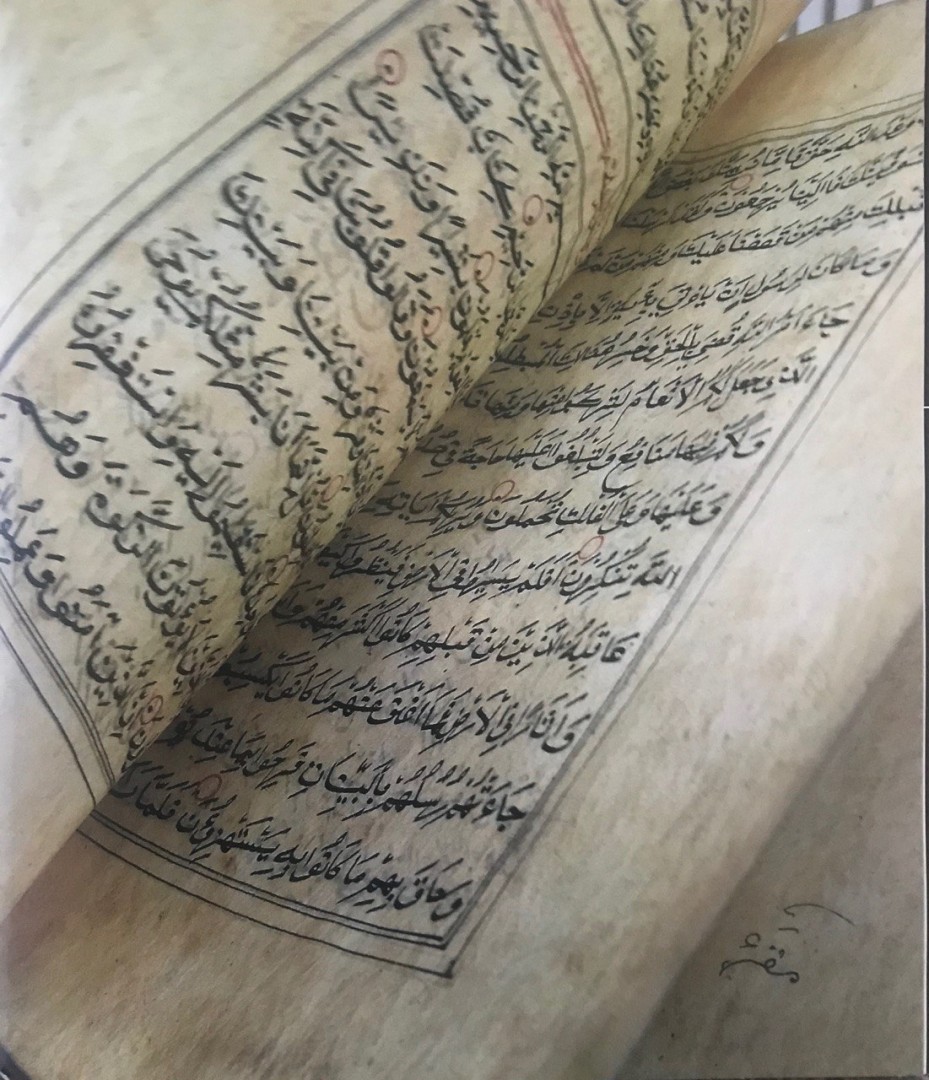
19th Century
19th Century

17th Century
17th Century
- Surah az-Zumar and Surah Ghafir both begin with the mention of making the Din purely for Him - مُخْلِصِينَ لَهُ الدِّينَ
-إِنَّا أَنزَلْنَا إِلَيْكَ الْكِتَابَ بِالْحَقِّ فَاعْبُدِ اللَّـهَ مُخْلِصًا لَّهُ الدِّينَ "Indeed, We have sent down to you the Book, [O Muhammad], in truth. So worship Allah, [being] sincere to Him in religion." (39:2)
فَادْعُوا اللَّـهَ مُخْلِصِينَ لَهُ الدِّينَ وَلَوْ كَرِهَ الْكَافِرُونَ "So invoke Allah, [being] sincere to Him in religion, although the disbelievers dislike it." (40:14) (40:65)
Total Word Count per Ayat (shows how many words per Ayat) = 1* | ||
| # | Root Word | Frequency in Surah | Frequency in Qur'an |
|---|---|---|---|
| 1. | أ ل ه | 57 | 2851 |
| 2. | ٱلَّذِى | 36 | 1464 |
| 3. | ك و ن | 25 | 1390 |
| 4. | ق و ل | 25 | 1722 |
| 5. | ر ب ب | 19 | 980 |
| 6. | د ع و | 18 | 212 |
| 7. | أ م ن | 17 | 879 |
| 8. | ي و م | 15 | 405 |
| 9. | إِلَّا | 13 | 663 |
| 10. | إِلَىٰ | 13 | 742 |
| Root Word | Frequency in Surah |
Frequency in Qur'an |
|---|---|---|
| أ ل ه | 57 | 2851 |
| ٱلَّذِى | 36 | 1464 |
| ك و ن | 25 | 1390 |
| ق و ل | 25 | 1722 |
| ر ب ب | 19 | 980 |
| د ع و | 18 | 212 |
| أ م ن | 17 | 879 |
| ي و م | 15 | 405 |
| إِلَّا | 13 | 663 |
| إِلَىٰ | 13 | 742 |
There are clear indications in the subject matter of this Surah to the conditions in which it was revealed. The disbelievers of Makkah at that time were engaged in two kinds of the activities against the Prophet. First, they were creating suspicion and misgiving in the minds of the people about the teaching of the Qur’an and the message of Islam and about the Prophet himself by starting many disputes and discussions, raising irrelevant objections and bringing ever new accusations so that the Prophet and the believers were sick of trying to answer them. Secondly, they were preparing the ground for putting an end to the Prophet himself. They were devising one plot after another, and on one occasion had even taken the practical steps to execute a plot. There is a hadith on the authority of Abdullah bin Amr bin al-As, saying that, one day when the Prophet was offering his prayers in the precincts of the Ka’bah, suddenly ‘Uqbah bin Abi Mu’ait, rushed forward and putting a piece of cloth round his neck started twisting it so as to strangle him to death. Abu Bakr, who happened to go there in time, pushed him away. Abdullah says that when Abu Bakr was struggling with the man, he was saying words to the effect: “Would you kill a man only because he says: God is my Lord?”
-
The following Surahs all have the letters, Ha-Meem as their opening Ayaat and interestingly what is common to all of them is their mentioning of the Prophet Musa. These Surahs are;
Surah 40: al-Ghafir
Surah 41: Fussilat
Surah 42: Shurah
Surah 43: Zukhruf
Surah 44: Dukhan
Surah 45: Jathiyah
Surah 46: al-Ahqaaf -
The angels who bear the throne of Allah pray for those humans who repent and follow the right way.
- A scene from the Day of Judgement.
- Allah knows the furtive looks and secret thoughts.
- Story of the Prophet Musa, Pharaoh, Haman and Qarun.
- An excellent speech of one of the relatives of Fir'on in favor of the Prophet Musa.
- Fir'on plotted against that relative, who was a believer, but Allah saved him and destroyed the people of Fir'on, and now they are presented before the fire of Hell every morning and evening.
- Allah says; "Call me, I will answer your prayers."
- No one has the right to be worshipped except Allah, the Creator and the Rabb of the world.
- Those who argue about the revelations of Allah will soon find out the Truth.
- Allah has sent many Rasools before Muhammad (pbuh): of them some are mentioned in the Qur'an and some are not.
- Belief after seeing the scourge of Allah is of no avail to the disbelievers.
Tafsir Zone
|
Overview (Verses 51 - 60) God's Unfailing Support The surah then adds a comment on the whole episode and what preceded it of reference to the different communities which suffered God's punishment after taking a negative attitude towards His message. We shall indeed support Our messengers and the believers both in this world's lift and on the Day when all the witnesses shall stand up. On that Day their excuses will be of no avail to the wrongdoers: their fate will be rejection, and they will have the worst of homes. And indeed We bestowed Our guidance on Moses, and passed down the Book to the Children of Israel as a guide and a reminder to people of understanding. Therefore, remain patient in adversity, for God's promise always comes true. Ask forgiveness for your sins, and extol your Lord's glory and praise evening and morning. (Verses 51-55) This definitive comment suits the decisive situation. We have been given an example of the end of truth and falsehood, both in this world and in the life to come. We have seen what fate befell Pharaoh and his noblemen in this life, and we have seen them disputing in hell, utterly humiliated. Such is the end of these communities, as stated in the Qur'an: "We shall indeed support Our messengers and the believers both in this world's life and on the Day when all the witnesses shall stand up. On that Day their excuses will be of no avail to the wrongdoers: their fate will be rejection, and they will have the worst of homes." (Verses 51-52) As for the life to come, perhaps no believer in life after death will argue about this. They do not find any reason to argue. As for victory in this present world, this may need some explanation. God's promise is clear and definitive: "We shall indeed support Our messengers and the believers both in this world's life and..." (Verse 51) Yet we see that some messengers were killed, and some had to abandon their homes after being rejected and driven out. Some believers have also been exposed to grievous suffering; some were thrown into the fire pit; some fell martyrs; some live in exceedingly difficult circumstances. What happens, then, to God's promise of support being given to them in this present life? Satan tries hard to exploit this situation, working hard to shake people's faith. People, however, use superficial measures when evaluating things, and they overlook many values and facts. They look at a brief period of time and a small area or space. These are limited human measures. A comprehensive look shows the situation to occur in a broad span of time and place. It does not erect limits between one era or place and another. If we look at the question of faith from such a broad perspective, we will see it triumphant, no doubt. Its triumph is the victory of its upholders. They have no existence separate from its existence. The first thing faith requires of them is to dedicate themselves to it completely, so that it is almost as if they disappear while it stays in full vision. Moreover, people often limit the meaning of victory to a specific outcome they know and can easily recognise. But victory can take different forms, some of which might superficially at least appear akin to defeat. When the Prophet Abraham was thrown in the fire and remained resolute in his determination to stick to his faith and advocate it, was he in a position of victory or defeat? From a faith perspective, he was undoubtedly at the highest point of victory as he was being cast into the fire. He again triumphed when he was saved from the fire. These are two different images that appear to be poles apart, but they are in fact very close to each other. Al-Husayn, the Prophet's grandson, met his martyrdom in a way that is tragic from one angle and splendid from another: so was he victorious or vanquished? On the surface, and judging by immediate considerations, it was a defeat. In reality and from a wider perspective, though, it was a true victory. No other martyr excites sympathy and feelings of support, among both Sunnis and Shi`ah, like al-Husayn. Indeed, such feelings also apply to many non-Muslims. Many are the martyrs who achieved for their faith through martyrdom what they could never have achieved in life had they lived a thousand years. They could not impress great meanings on people's minds or motivate them to action like they did with their final sermon, written with their own blood. Their martyrdom provided motivation for their children and grandchildren, and at times they provided the motivation to change history over several generations.' What constitutes victory? What is meant by defeat? We need to review our concepts and our sense of values before we ask about whether God's promise to His messengers and to believers comes true in this present life? Yet there are many situations where victory takes its familiar form, particularly when such form is linked to a permanent one. The Prophet Muhammad achieved victory in his lifetime because his victory was necessary for the establishment of the faith in its full reality in human life. This faith of ours can only be brought to its fullness when it governs the life of its community. It can, thus, conduct all affairs, from those of a single heart and soul to those of state and government. It was God's will that the messenger preaching this faith should triumph during his own lifetime, so that he could establish the full form of the Islamic faith, leaving a real example for future generations. Thus, the familiar form of victory was linked in his case to a much wider one, and the two were united by God's will and according to His planning. Another point to consider is that God's promise is given to His messengers and to believers. Thus, a prerequisite for victory is the presence of true faith in people's hearts so as to make the promise applicable to them. Yet people often overlook the significance of the truth of faith which comes into existence only when people remove all forms of idolatry. There are some very subtle forms of idolatry which can only be purged when a person is totally devoted to God, relies on Him alone and submits totally to His will in all affairs. He then feels that God guides His footsteps and that He chooses nothing other than what God has chosen for him. Thus, he accepts God's will with contentment. When a person attains this state, he does not suggest to God any particular form of victory. He leaves the matter to God to determine. He accepts whatever befalls him as good. This is one of the meanings of victory. It is victory over one's pleasures and desires. It is an internal victory, one that is prerequisite for achieving the external victory: "We shall indeed support Our messengers and the believers both in this world's lift and on the Day when all the witnesses shall stand up. On that Day their excuses will be of no avail to the wrongdoers: their fate will be rejection, and they will have the worst of homes." (Verses 51-52) We have seen in the previous image drawn how the excuses advanced by the wrongdoers were of little use to them, and how they were rejected and made to dwell in the worst of homes. Moses' story shows yet another form of victory: "And indeed, We bestowed Our guidance on Moses, and passed down the Rook to the Children of Israel as a guide and a reminder to people of understanding." (Verses 53-54) Providing guidance and passing the book down to them was a form of victory that clearly reflects the breadth of its scope. The final note in this part of the surah is given in the form of a directive to the Prophet and the believers facing much hardship in Makkah, and to all future generations of believers who face such hardship: "Therefore, remain patient in adversity, for God's promise always comes true. Ask forgiveness for your sins, and extol your Lord's glory and praise evening and morning." (Verse 55) Remain patient in adversity, whether this adversity takes the form of rejection of the message, denying its truth, or the infliction of physical harm. Remain patient when you are unable to check falsehood that appears to enjoy wealth and power for a period of time. Bear with patience what you have to face of people's rough attitudes and behaviour. Check your own desire to achieve a quick victory. Remain patient as you may have to face many difficulties caused by friends, if not by enemies. "Remain patient in adversity, for God's promise always comes true." (Verse 55) It may appear slow coming; matters may become complicated; prospects may become gloomy; yet it is the promise of the One who can fulfil it, and whose will it has been to make the promise. As you go along your way, take the necessary equipment: "Ask forgiveness for your sins, and extol your Lord's glory and praise evening and morning." (Verse 55) This is what is of most benefit along the hard way of patience; seeking forgiveness of one's sins and extolling God's praise and glory. While this serves to refine our hearts and feelings, it also ensures a positive response. Indeed, it is through such seeking of forgiveness and extolling of God's praise and glory that victory is achieved within our selves, to be followed by victory in life. The evening and morning are specified either as a reference to all time, since these are the two ends of the day, or because these are times when hearts are calm and reflective. They can, thus, appreciate God's greatness better. Such is the way, then, that God has chosen to provide the necessary equipment for achieving victory. |
Ibn Kathir (English)
Sayyid Qutb
Sha'rawi
Al Jalalain
Mawdudi
الطبري - جامع البيان
ابن كثير - تفسير القرآن العظيم
القرطبي - الجامع لأحكام
البغوي - معالم التنزيل
ابن أبي حاتم الرازي - تفسير القرآن
ابن عاشور - التحرير والتنوير
ابن القيم - تفسير ابن قيّم
السيوطي - الدر المنثور
الشنقيطي - أضواء البيان
ابن الجوزي - زاد المسير
الآلوسي - روح المعاني
ابن عطية - المحرر الوجيز
الرازي - مفاتيح الغيب
أبو السعود - إرشاد العقل السليم
الزمخشري - الكشاف
البقاعي - نظم الدرر
الهداية إلى بلوغ النهاية — مكي ابن أبي طالب
القاسمي - محاسن التأويل
الماوردي - النكت والعيون
السعدي - تيسير الكريم الرحمن
عبد الرحمن الثعالبي - الجواهر الحسان
السمرقندي - بحر العلوم
أبو إسحاق الثعلبي - الكشف والبيان
الشوكاني - فتح القدير
النيسابوري - التفسير البسيط
أبو حيان - البحر المحيط
البيضاوي - أنوار التنزيل
النسفي - مدارك التنزيل
ابن جُزَيّ - التسهيل لعلوم التنزيل
علي الواحدي النيسابوري - الوجيز
السيوطي - تفسير الجلالين
المختصر في التفسير — مركز تفسير
|
|
Overview (Verses 51 - 60) God's Unfailing Support The surah then adds a comment on the whole episode and what preceded it of reference to the different communities which suffered God's punishment after taking a negative attitude towards His message. We shall indeed support Our messengers and the believers both in this world's lift and on the Day when all the witnesses shall stand up. On that Day their excuses will be of no avail to the wrongdoers: their fate will be rejection, and they will have the worst of homes. And indeed We bestowed Our guidance on Moses, and passed down the Book to the Children of Israel as a guide and a reminder to people of understanding. Therefore, remain patient in adversity, for God's promise always comes true. Ask forgiveness for your sins, and extol your Lord's glory and praise evening and morning. (Verses 51-55) This definitive comment suits the decisive situation. We have been given an example of the end of truth and falsehood, both in this world and in the life to come. We have seen what fate befell Pharaoh and his noblemen in this life, and we have seen them disputing in hell, utterly humiliated. Such is the end of these communities, as stated in the Qur'an: "We shall indeed support Our messengers and the believers both in this world's life and on the Day when all the witnesses shall stand up. On that Day their excuses will be of no avail to the wrongdoers: their fate will be rejection, and they will have the worst of homes." (Verses 51-52) As for the life to come, perhaps no believer in life after death will argue about this. They do not find any reason to argue. As for victory in this present world, this may need some explanation. God's promise is clear and definitive: "We shall indeed support Our messengers and the believers both in this world's life and..." (Verse 51) Yet we see that some messengers were killed, and some had to abandon their homes after being rejected and driven out. Some believers have also been exposed to grievous suffering; some were thrown into the fire pit; some fell martyrs; some live in exceedingly difficult circumstances. What happens, then, to God's promise of support being given to them in this present life? Satan tries hard to exploit this situation, working hard to shake people's faith. People, however, use superficial measures when evaluating things, and they overlook many values and facts. They look at a brief period of time and a small area or space. These are limited human measures. A comprehensive look shows the situation to occur in a broad span of time and place. It does not erect limits between one era or place and another. If we look at the question of faith from such a broad perspective, we will see it triumphant, no doubt. Its triumph is the victory of its upholders. They have no existence separate from its existence. The first thing faith requires of them is to dedicate themselves to it completely, so that it is almost as if they disappear while it stays in full vision. Moreover, people often limit the meaning of victory to a specific outcome they know and can easily recognise. But victory can take different forms, some of which might superficially at least appear akin to defeat. When the Prophet Abraham was thrown in the fire and remained resolute in his determination to stick to his faith and advocate it, was he in a position of victory or defeat? From a faith perspective, he was undoubtedly at the highest point of victory as he was being cast into the fire. He again triumphed when he was saved from the fire. These are two different images that appear to be poles apart, but they are in fact very close to each other. Al-Husayn, the Prophet's grandson, met his martyrdom in a way that is tragic from one angle and splendid from another: so was he victorious or vanquished? On the surface, and judging by immediate considerations, it was a defeat. In reality and from a wider perspective, though, it was a true victory. No other martyr excites sympathy and feelings of support, among both Sunnis and Shi`ah, like al-Husayn. Indeed, such feelings also apply to many non-Muslims. Many are the martyrs who achieved for their faith through martyrdom what they could never have achieved in life had they lived a thousand years. They could not impress great meanings on people's minds or motivate them to action like they did with their final sermon, written with their own blood. Their martyrdom provided motivation for their children and grandchildren, and at times they provided the motivation to change history over several generations.' What constitutes victory? What is meant by defeat? We need to review our concepts and our sense of values before we ask about whether God's promise to His messengers and to believers comes true in this present life? Yet there are many situations where victory takes its familiar form, particularly when such form is linked to a permanent one. The Prophet Muhammad achieved victory in his lifetime because his victory was necessary for the establishment of the faith in its full reality in human life. This faith of ours can only be brought to its fullness when it governs the life of its community. It can, thus, conduct all affairs, from those of a single heart and soul to those of state and government. It was God's will that the messenger preaching this faith should triumph during his own lifetime, so that he could establish the full form of the Islamic faith, leaving a real example for future generations. Thus, the familiar form of victory was linked in his case to a much wider one, and the two were united by God's will and according to His planning. Another point to consider is that God's promise is given to His messengers and to believers. Thus, a prerequisite for victory is the presence of true faith in people's hearts so as to make the promise applicable to them. Yet people often overlook the significance of the truth of faith which comes into existence only when people remove all forms of idolatry. There are some very subtle forms of idolatry which can only be purged when a person is totally devoted to God, relies on Him alone and submits totally to His will in all affairs. He then feels that God guides His footsteps and that He chooses nothing other than what God has chosen for him. Thus, he accepts God's will with contentment. When a person attains this state, he does not suggest to God any particular form of victory. He leaves the matter to God to determine. He accepts whatever befalls him as good. This is one of the meanings of victory. It is victory over one's pleasures and desires. It is an internal victory, one that is prerequisite for achieving the external victory: "We shall indeed support Our messengers and the believers both in this world's lift and on the Day when all the witnesses shall stand up. On that Day their excuses will be of no avail to the wrongdoers: their fate will be rejection, and they will have the worst of homes." (Verses 51-52) We have seen in the previous image drawn how the excuses advanced by the wrongdoers were of little use to them, and how they were rejected and made to dwell in the worst of homes. Moses' story shows yet another form of victory: "And indeed, We bestowed Our guidance on Moses, and passed down the Rook to the Children of Israel as a guide and a reminder to people of understanding." (Verses 53-54) Providing guidance and passing the book down to them was a form of victory that clearly reflects the breadth of its scope. The final note in this part of the surah is given in the form of a directive to the Prophet and the believers facing much hardship in Makkah, and to all future generations of believers who face such hardship: "Therefore, remain patient in adversity, for God's promise always comes true. Ask forgiveness for your sins, and extol your Lord's glory and praise evening and morning." (Verse 55) Remain patient in adversity, whether this adversity takes the form of rejection of the message, denying its truth, or the infliction of physical harm. Remain patient when you are unable to check falsehood that appears to enjoy wealth and power for a period of time. Bear with patience what you have to face of people's rough attitudes and behaviour. Check your own desire to achieve a quick victory. Remain patient as you may have to face many difficulties caused by friends, if not by enemies. "Remain patient in adversity, for God's promise always comes true." (Verse 55) It may appear slow coming; matters may become complicated; prospects may become gloomy; yet it is the promise of the One who can fulfil it, and whose will it has been to make the promise. As you go along your way, take the necessary equipment: "Ask forgiveness for your sins, and extol your Lord's glory and praise evening and morning." (Verse 55) This is what is of most benefit along the hard way of patience; seeking forgiveness of one's sins and extolling God's praise and glory. While this serves to refine our hearts and feelings, it also ensures a positive response. Indeed, it is through such seeking of forgiveness and extolling of God's praise and glory that victory is achieved within our selves, to be followed by victory in life. The evening and morning are specified either as a reference to all time, since these are the two ends of the day, or because these are times when hearts are calm and reflective. They can, thus, appreciate God's greatness better. Such is the way, then, that God has chosen to provide the necessary equipment for achieving victory. |
- Surah 40. Ghafir - Saad al Ghamidi https://www.youtube.com/watch?v=q5Onjs1b4g8&list=PLhM2xiAUdw2cAqW_o3zZkbhJNw0bnaBZN&index=40
- Surah 40. Ghafir Mahmoud Khalil Al Hussary https://www.youtube.com/watch?v=VDvrxnUX38g&index=40&list=PLxpAkjlGauHfMFWX22VZWOKpzjr-vH_BM
- Surah 40. Ghafir Muhammad Al Luhaydan https://www.youtube.com/watch?v=9ZxSQZ-JvZA&index=40&list=PLxpAkjlGauHfKAYuQLRNAZomoezhfhRZe
- Idris Akbar Surah Ghafir https://www.youtube.com/watch?v=IY1b_q4bofQ
- Surah 40.Ghafir muhammad Minshawi https://www.youtube.com/watch?v=zPMGO7guV1c&list=PLxpAkjlGauHdUcO_uc-8F8J2NUQRDZjPG&index=40
- Dr Israr Ahmed Tafsir Surah Al-M'umin (47) to Surah Al-Shura (1-13)1 https://www.youtube.com/watch?v=pv80yaqL00A&list=PLB4B8D1654A8BD263&index=89
- Surah Al-M'umin (47) to Surah Al-Shura (1-13)2 https://www.youtube.com/watch?v=i8EU2FqF2tk&list=PLB4B8D1654A8BD263&index=90


